
Quilter
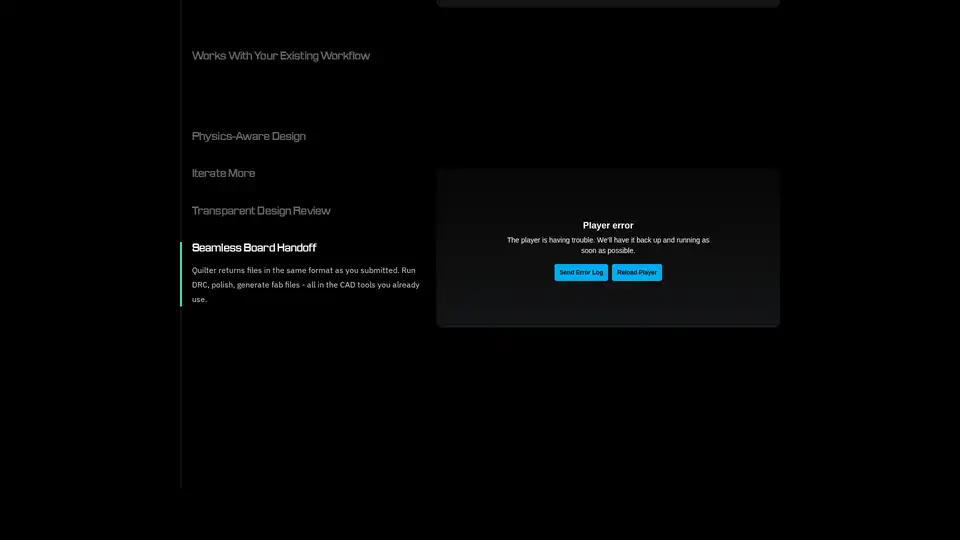
Overview of Quilter
What is Quilter? Physics-Driven AI for Electronics Design
In the complex world of electronics hardware development, the process of Printed Circuit Board (PCB) layout is notoriously time-consuming, prone to errors, and a significant bottleneck for innovation. Engineers and designers often spend weeks or even months meticulously placing components and routing traces, juggling numerous physical constraints, signal integrity requirements, and manufacturing considerations. This manual, iterative process can slow down product development cycles, increase costs, and limit the ability to explore innovative designs.
Quilter emerges as a groundbreaking solution, leveraging physics-driven AI and reinforcement learning to fundamentally transform PCB layout. It's an advanced platform designed to automate the complete PCB layout process, converting what traditionally takes months into mere minutes or hours. By integrating sophisticated AI capabilities with a deep understanding of physical design principles, Quilter empowers hardware teams to achieve unprecedented levels of speed, accuracy, and confidence in their designs, ultimately accelerating the journey from schematic to a functional board on a desk.
How Does Quilter Revolutionize Electronics Design?
Quilter isn't just an automation tool; it's a strategic partner for hardware development, offering a suite of features that address the most pressing challenges in electronics design. Its core value lies in its ability to streamline complex tasks, improve design quality, and foster rapid innovation.
Physics-Driven AI for Unmatched Accuracy
At the heart of Quilter's innovation is its "Physics-First AI" approach. Traditional layout tools rely heavily on human expertise and rules-based systems, which can miss subtle physical interactions or lead to suboptimal designs. Quilter, however, employs reinforcement learning algorithms that are trained on vast datasets of physical principles and successful designs. This allows the AI to:
- Identify Critical Considerations Automatically: Quilter intelligently recognizes and accounts for crucial design elements such as bypass capacitors, impedance-controlled nets, and differential pairs. It understands the implications of these elements on signal integrity and power delivery.
- Ensure Functionality: Every proposed layout candidate undergoes an extensive physics design review by the AI itself. This proactive validation ensures that the design inherently respects physical constraints and is poised for functionality, reducing the likelihood of costly re-spins.
- Transparent Constraint Management: Users define the board outline, pre-place connectors, and determine the floorplan, setting the constraints. Quilter then clearly communicates which physical considerations it will account for and how, providing engineers with full visibility and control.
Seamless Integration with Existing Workflows
A key advantage of Quilter is its commitment to working within an engineer's familiar ecosystem. Instead of forcing teams to adopt entirely new toolchains, Quilter offers:
- Direct Project Uploads: Users can upload projects directly from industry-standard CAD tools like Altium, Cadence, Siemens, or KiCAD. This eliminates the friction associated with data conversion or learning new interfaces for initial project setup.
- Familiar File Formats: After the AI-driven layout process, Quilter returns files in the same format as they were submitted. This allows engineers to seamlessly transition back to their preferred CAD environment to run Design Rule Checks (DRC), perform final polishing, and generate fabrication files without disruption.
- Augmenting, Not Replacing, Expertise: Quilter empowers engineers and PCB designers by handling the laborious, repetitive aspects of layout. This frees up human bandwidth to focus on complex, high-value tasks, critical thinking, and driving genuine breakthroughs in product design.
Accelerating Design Iteration and Exploration
The speed and efficiency offered by Quilter fundamentally change the design paradigm, enabling far greater exploration and optimization:
- Generate Multiple Candidates in Hours: Instead of spending weeks on a single layout iteration, Quilter can generate multiple viable layout candidates in a fraction of the time. This rapid prototyping capability is invaluable.
- Parallel Exploration: Engineers can simultaneously experiment with various design parameters, including different stack-ups, multiple manufacturers' specifications, and diverse form factors. This parallel exploration significantly reduces the overall design cycle time.
- "Layout Fast and Abundant": Quilter makes the process of creating and refining layouts so efficient that iteration becomes a strength, not a chore. This leads to more optimized, robust, and innovative designs.
Transparent Design Review for Confidence
Quilter provides unparalleled clarity throughout the design process, building confidence in the AI-generated outputs:
- Comprehensive Evaluation: The platform rigorously evaluates each layout candidate against the complete list of physical constraints provided by the user.
- Clear Feedback: Engineers receive precise and actionable feedback, clearly indicating which design aspects are truly "done" and meet all requirements, and which areas might still need further human review or improvement. This transparency ensures engineers remain in control and fully understand the rationale behind the AI's choices.
Effortless Handoff to Manufacturing
The final stage of PCB design is crucial for successful manufacturing. Quilter ensures a smooth transition:
- Production-Ready Files: By returning files in native CAD formats, Quilter facilitates an easy handoff for final checks and fabrication file generation within the existing toolset. This minimizes the risk of errors often introduced during format conversions or manual data transfers.
Who Can Benefit from Quilter?
Quilter is an indispensable tool for a wide range of professionals and organizations involved in hardware development:
- Electronics Design Engineers: Those spending significant time on manual PCB layout can offload repetitive tasks, allowing them to focus on higher-level architectural design and problem-solving.
- PCB Layout Specialists: Professionals dedicated to layout can dramatically increase their throughput and tackle more projects without increasing overhead.
- Hardware Startups: Startups often operate with limited resources and tight deadlines. Quilter can significantly accelerate their product development cycles, bringing products to market faster and more cost-effectively.
- Large Enterprises and R&D Teams: Companies developing complex, mission-critical hardware (e.g., aerospace, medical devices, automotive, industrial automation) will benefit from the increased confidence, accuracy, and speed in their design processes.
- Education and Research Institutions: Universities and research labs can use Quilter to rapidly prototype new hardware designs for academic projects and cutting-edge research.
How Does Quilter Work? Understanding the Physics-Driven AI
At its core, Quilter leverages reinforcement learning (RL), a branch of AI where an agent learns to make decisions by performing actions in an environment and receiving rewards or penalties. In Quilter's case:
- Environment: The PCB design space, defined by board outline, component placement, and physical constraints.
- Agent: The Quilter AI, which makes decisions about component routing, trace placement, and layer assignments.
- Actions: Placing components, routing traces, optimizing vias, selecting stack-ups, etc.
- Reward Function: This is where the "physics-driven" aspect comes in. The AI is rewarded for layouts that satisfy electrical, thermal, mechanical, and manufacturing constraints. It's penalized for violations. The reward function incorporates deep knowledge of signal integrity, power integrity, manufacturability (DFM), and design rule checks (DRC).
Through millions of iterations in a simulated environment, Quilter's RL agent learns optimal strategies for laying out PCBs. Unlike traditional heuristic-based algorithms, RL allows Quilter to discover novel and highly efficient layout solutions that might not be immediately obvious to human designers. The "Physics-First Confidence" means that these learned solutions are inherently validated against physical principles, minimizing guesswork and rework.
Why Choose Quilter? Unlocking Practical Value
Choosing Quilter means investing in a future where hardware development is faster, more reliable, and more innovative. The practical value it delivers is multifaceted:
- Dramatic Time Savings: Transforms months of layout work into hours, freeing up valuable engineering time.
- Increased Engineering Bandwidth: Allows engineers to focus on creativity, innovation, and complex problem-solving rather than tedious layout tasks.
- Enhanced Design Quality: Physics-first validation ensures designs are functionally robust and meet stringent requirements from the outset.
- Faster Time-to-Market: Accelerates product development cycles, giving businesses a competitive edge.
- Cost Reduction: Minimizes expensive design re-spins and accelerates prototyping, leading to overall project cost savings.
- Risk Mitigation: Proactive identification and resolution of physical constraints reduce manufacturing risks and post-production issues.
- Design Exploration: Facilitates the exploration of multiple design candidates and optimizations in parallel, leading to superior final products.
- Enterprise-Grade Support: For mission-critical environments, Quilter offers premium, proactive support tailored for high-stakes PCB development.
Key Features at a Glance
- Physics-Driven AI: Utilizes reinforcement learning for optimal, physically validated PCB layouts.
- CAD Tool Compatibility: Direct integration with Altium, Cadence, Siemens, and KiCAD projects.
- Rapid Iteration: Generate multiple layout candidates in hours, not weeks.
- Transparent Review: Clear feedback on design compliance with physical constraints.
- Seamless Handoff: Returns native CAD files for easy manufacturing preparation.
- Constraint-Driven Design: Users define board outline, component pre-placement, and floorplan.
- Automated Critical Consideration Identification: Detects bypass capacitors, impedance nets, differential pairs.
- Focus on High-Value Tasks: Frees engineers for complex problem-solving.
- Enterprise-Grade Support: Dedicated assistance for mission-critical projects.
The Future of Hardware Development with AI
Quilter represents a significant leap forward in the application of AI to physical engineering challenges. By automating the foundational, yet intricate, process of PCB layout, it paves the way for a new era of "Hardware Rich Development." This paradigm shift enables companies to:
- Innovate Faster: Rapid prototyping and iteration cycles allow for quicker experimentation and validation of new ideas.
- Design More Complex Systems: AI can handle the growing complexity of modern electronics, managing thousands of components and intricate routing paths that would overwhelm human designers.
- Optimize for Multiple Objectives: Quilter can potentially optimize layouts not just for electrical performance, but also for thermal management, manufacturability, cost, and even environmental impact simultaneously.
- Democratize Advanced Design: By simplifying complex layout tasks, Quilter could lower the barrier to entry for advanced hardware design, enabling more individuals and smaller teams to create sophisticated electronic products.
Quilter: Addressing Critical Industry Challenges
The electronics industry faces continuous pressure for smaller, faster, more power-efficient, and more reliable devices. Traditional design methodologies struggle to keep pace with these demands. Quilter directly addresses these challenges by:
- Reducing Design Time: Directly tackles the critical issue of long development cycles.
- Improving Design Reliability: Ensures first-pass success rates are higher due to physics-first validation.
- Optimizing Resource Allocation: Maximizes the impact of highly skilled engineers by reallocating their time from mundane to innovative tasks.
- Enhancing Scalability: Allows design teams to take on more projects or more complex projects without proportional increases in headcount.
Getting Started with Quilter
For those ready to experience the future of electronics design, getting started with Quilter is straightforward. The platform likely offers various entry points, including:
- Free Version: A "Free Version" is mentioned, suggesting an opportunity to explore basic functionalities.
- Startup Program: Tailored support for emerging companies, indicating a commitment to nurturing innovation.
- Contact/Demo: Options to connect with the Quilter team for personalized demonstrations and discussions on specific project needs.
- Logging In/Getting Started: Typical web application flow for immediate access to the platform upon registration.
Conclusion: Transform Your PCB Layout with Quilter AI
Quilter stands as a testament to the power of integrating cutting-edge AI with deep engineering principles. It’s more than just a tool; it's a paradigm shift for electronics design AI. By automating the intricate and time-consuming process of PCB layout through physics-driven AI and reinforcement learning, Quilter empowers engineers, accelerates development cycles, and ensures hardware designs are not only functional but optimized for performance and manufacturability. For any organization aiming to push the boundaries of hardware innovation and achieve unparalleled efficiency, Quilter offers a compelling and transformative solution. Embrace the future of hardware design automation and let Quilter turn your complex design challenges into streamlined successes.
Best Alternative Tools to "Quilter"
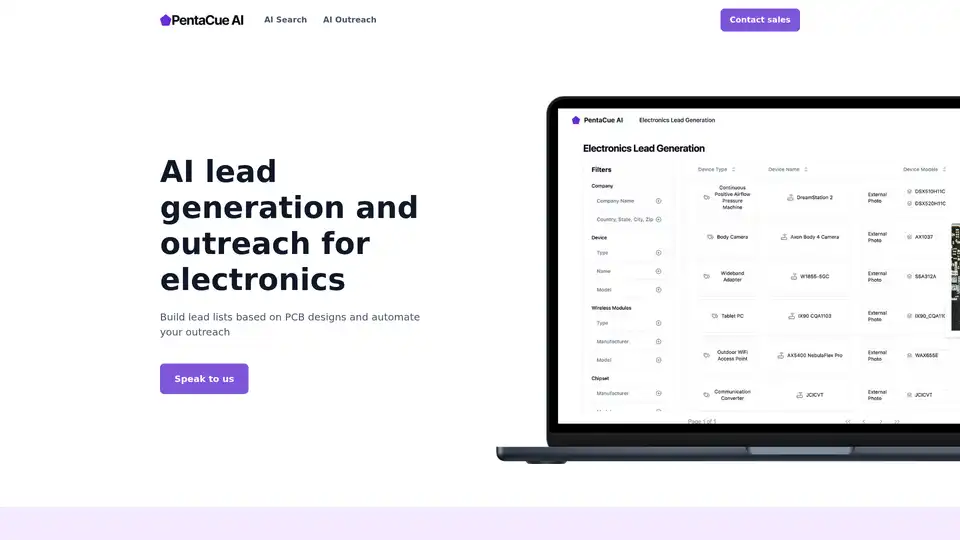
PentaCue AI uses artificial intelligence to analyze PCB designs and identify sales opportunities for electronics components. The platform automates outreach to decision makers through multiple channels.
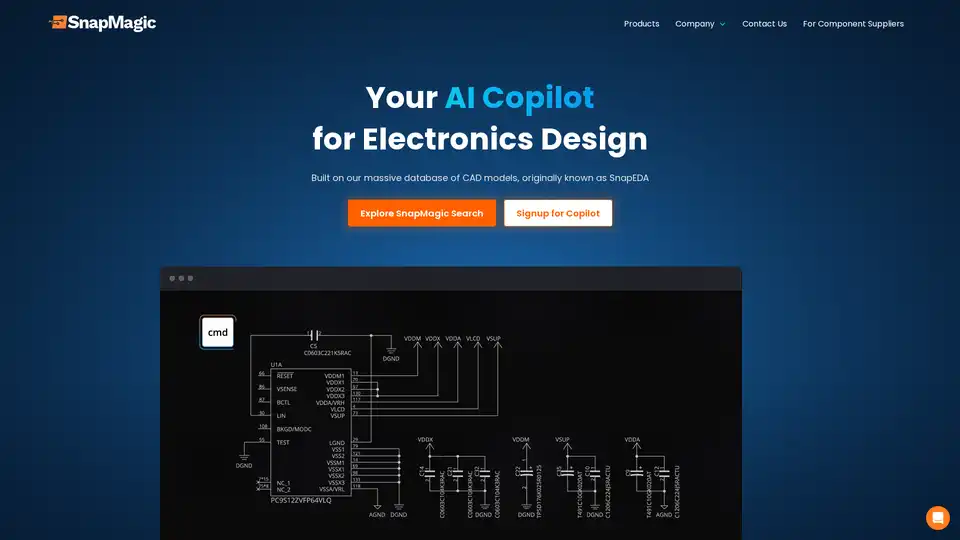
SnapMagic is an AI copilot for electronics design, integrating with existing PCB tools to automate circuit board design. Optimize BOMs, find component replacements, and streamline your workflow.
Intelgic automates industrial processes with AI-powered vision systems, specializing in custom AOI systems integrating machine vision, industrial optics, precision robotics, and AI software for zero defect manufacturing.
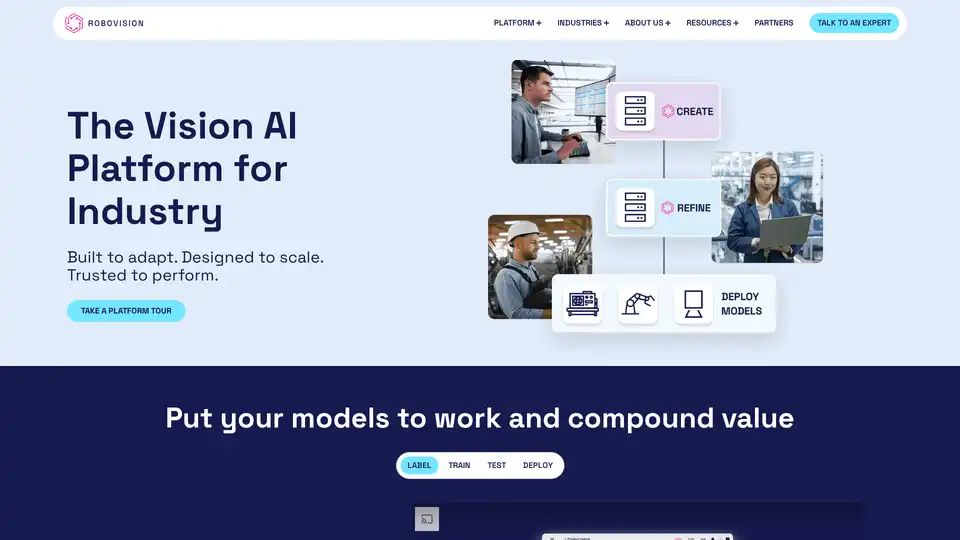
Robovision is a vision AI platform for industry, designed to adapt and scale, offering solutions for labeling, training, testing, and deploying AI models.